




You need direct access to decision-makers, but CEO email addresses aren’t publicly available. Traditional prospecting methods waste hours with minimal results, leaving your outreach campaigns stuck before they start.
There’s a better approach.
Twelve proven techniques exist that’ll help you locate executive contacts efficiently, combining digital tools, strategic networking, and verification methods.
Each method offers specific advantages depending on your industry, target company size, and available resources.
What Is the Best Way to Find CEO Email Addresses?
Finding CEO email addresses doesn’t have to drain your budget or waste hours on research. A waterfall enrichment tool like BetterContact delivers the highest success rates by combining over 20 data sources, including Apollo and Hunter, into a single streamlined email finder.
You’ll access 3 billion+ contact data points with 99.5% email verification accuracy, ensuring you reach the right CEO every time. This contact method outperforms single-source tools through intelligent multi-layer verification and SMTP validation.
Pay-per-result pricing means you only spend credits when valid email addresses are found. For sales automation workflows, BetterContact integrates directly with HubSpot, Clay, and Zapier, automatically enriching your CRM with verified CEO contacts.
You’ll contact 1.6x more leads while maintaining superior data quality across your entire pipeline.
1. Use a Sales Intelligence Tool
Sales intelligence tools transform the CEO prospecting process by aggregating contact data from dozens of sources into a single platform. These systems deliver superior accuracy compared to manual searches, with top platforms achieving 99.5% email verification rates for business development campaigns.
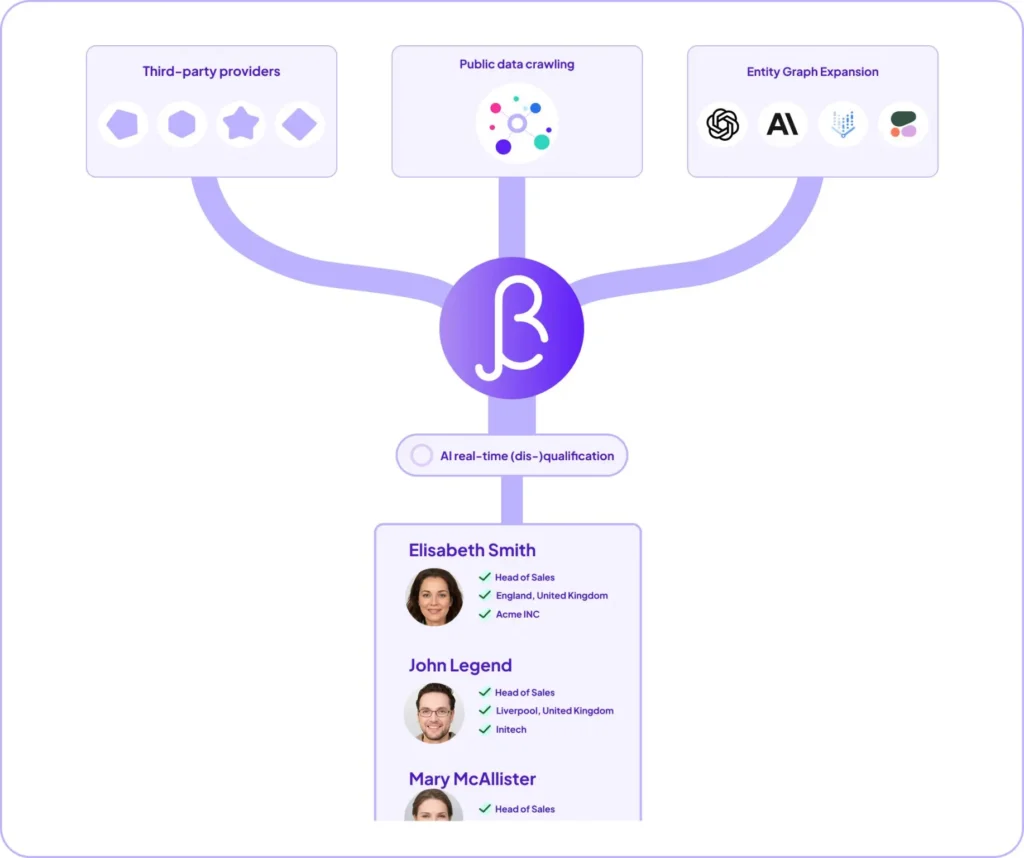
Using BetterContact, you can build a live lead list from several sources, and it employs waterfall enrichment technology. This approach queries multiple databases simultaneously, increasing contact information discovery rates by 5-10% over single-source providers.
You’ll access verified emails from 3 billion+ contacts across global markets.
Key advantages include:
- Pay-per-result pricing models that charge only for successfully verified emails
- Multi-layer SMTP verification ensuring deliverability
- Real-time job title and company validation
- Native CRM integrations with HubSpot and automation platforms
Sales intelligence platforms eliminate the need for multiple subscriptions while maintaining data quality standards essential for executive outreach.
2. Search LinkedIn
LinkedIn serves as a direct pathway to CEO contact information, though success rates vary considerably by company size.

Start by searching for the CEO’s name, or navigate to the company profile and click the People tab. Small to medium business owners often list email addresses directly in their contact information.
If you can’t find their email immediately, send a connection request. LinkedIn sometimes reveals email addresses once you’re connected. Alternatively, request an introduction through mutual connections who already have access to the CEO’s profile.
For scaled outreach, consider LinkedIn Sales Navigator. This paid platform offers advanced search filters to help you identify CEOs in your target market.
You can then export these profiles to data enrichment tools that provide verified email addresses and direct-dial numbers.
3. DM on LinkedIn
Sometimes you won’t find a CEO’s email address through traditional methods, making direct messaging on LinkedIn your most practical option.
Before sending a personalized connection request, optimize your LinkedIn profile to establish credibility. Engage first by commenting thoughtfully on their posts for 3-5 days. This approach works better than b2b contact databases or an email lookup tool for building genuine rapport.
When ready, craft a concise message mentioning specific details from their recent activity. Reference shared interests or challenges relevant to their industry.
Keep your initial ask small, don’t pitch immediately. Instead, offer value through a useful resource or a simple question. Your message should be no more than 75 words.
Focus on their needs, not yours. Personalization and genuine helpfulness generate responses far more effectively than generic outreach.
Best LinkedIn DM Automation Tool: HeyReach
4. Check Other Social Media
Beyond LinkedIn, CEOs often maintain active presences on Twitter, Facebook, Instagram, and industry-specific platforms where they share insights and engage with their audience.
Review their profile bios for publicly listed contact details. Many executives include business email addresses directly in their social media profiles, making prospect research straightforward.
Engage with their content through comments and shares to establish rapport before requesting their email address. This approach builds credibility and increases response rates when you eventually reach out directly.
Cross-reference information from multiple social media platforms with industry directories to verify accuracy.
Check platform-specific features, such as Twitter’s website links or Facebook’s “About” sections. Some CEOs maintain separate professional accounts specifically for business use, where they’re more likely to share contact information for networking.
Here’s the automation tool for that: TweetScraper.
5. DM on Twitter
When public direct messages are enabled on a CEO’s X profile, you’ll see an envelope icon next to their name, signaling an opportunity to reach them directly without needing their email address.
Before initiating contact, verify the DM feature is available on their profile. Click the envelope icon to open direct communication.
Craft your message strategically:
- Limit your message to 2-3 sentences maximum
- Reference specific recent posts to demonstrate genuine interest
- Lead with value rather than requests
- Include a soft call-to-action requiring minimal effort
Avoid generic templates that executives instantly recognize as mass outreach.
Proofread thoroughly before sending; errors undermine your credibility. If you don’t receive a response within several days, send a polite follow-up.
Here’s the tool to automate the process: MeetAlfred.

This public-facing communication channel often proves more accessible than traditional email verification methods.
6. Research Company Website
The company website remains the most direct source for verified CEO contact information, particularly for organizations that prioritize transparency. Navigate to the “About Us” or “Leadership Team” sections first. You’ll often find detailed CEO bio pages containing direct contact information.
Follow this research process:
- Scan executive leadership team pages for email addresses listed alongside profiles
- Check the main contact page for departmental email directories
- Review press release sections where the CEO’s contact information appears
- Examine investor relations pages that frequently include executive contacts
Company websites that make leadership contact details publicly available typically display consistent email formats. Note the pattern; it’ll help you construct addresses for other executives.
This method incurs no cost and provides verified information directly from the source, though its success depends entirely on the organization’s transparency policies.
7. Knock Alumni
Alumni networks create unexpected pathways to CEO contact information that many professionals overlook. If you share an alma mater with your target CEO, you’ve gained immediate access to contact data through university directories and alumni platforms.
These connections offer a free alternative to paid databases while providing opportunities for warm introductions.
Leverage Your Alumni Network:
- Search your university’s alumni directory for the CEO’s profile
- Identify mutual connections who can provide a referral
- Contact fellow graduates who work at the target company
- Request introductions through professional alumni groups
Alumni networks eliminate cold outreach barriers. You’ll find detailed profiles containing current positions and contact information.
However, this method proves time-consuming when building relationships and waiting for responses. Your success depends entirely on existing connections within the network.
8. Google Search Operators
Before investing in premium tools, you’ll want to master Google’s search operators and specialized commands that transform basic searches into precision contact-finding instruments.
These operators let you search within specific domains to efficiently locate executive contact information.
Use these exact search formulas:
- site:company.com “first name” “last name” email
- site:domain.com firstname.lastname@
- site:company.com “contact info button” CEO
The site: operator restricts results to one domain, eliminating irrelevant matches.
Combine the executive’s first name and last name with their company domain for targeted results. You can also search variations like first initial plus last name.
This method works best for smaller organizations where executives’ contact details are publicly available.
Larger corporations typically shield this information, making Google searches less effective despite your efforts.
9. Check Directories
While Google searches work well for publicly visible contacts, industry-specific directories offer a more structured approach to finding CEO email addresses. These email databases compile verified contact information for b2b decision-makers across various sectors.
Start by identifying directories relevant to your target CEO’s industry. Professional associations, chamber of commerce listings, and public directories often maintain executive contact details.
Many platforms, such as ZoomInfo, Apollo.io, and LinkedIn Sales Navigator, provide access to CEO email addresses, though premium features typically require paid subscriptions.
Free options include:
- Industry trade association member directories
- Conference attendee lists from industry events
- Business registry databases maintained by government agencies
If directories don’t yield results, you can always contact the company directly by calling their main line and requesting the CEO’s email address from reception or investor relations.
10. Join Events
Attending industry conferences and corporate events gives you direct access to CEOs in professional settings where contact exchange is expected. You’ll find networking sessions, panel discussions, and social mixers designed to facilitate business card exchanges and contact sharing.
Target trade shows relevant to your CEO’s industry for maximum results.
Key Actions:
- Arrive early to networking sessions when CEOs are most accessible
- Prepare your elevator pitch in advance
- Collect business cards from executives and their assistants
- Connect on LinkedIn immediately after the meeting
- Request email addresses during natural conversation breaks
These face-to-face opportunities create memorable impressions that cold emails can’t match.
Professional events lower barriers to contact exchange since attendees expect outreach. You’ll invest significant time and money, but direct connections with CEOs often justify these costs.
11. Cold Call Company
Cold calling remains one of the most direct methods to obtain CEO email addresses when online research hits a dead end.
If you’ve exhausted the company website and digital outreach channels, a phone number becomes your primary tool.
Assign team members to systematically call target companies. You’ll typically encounter receptionists or executive assistants at larger organizations, so prepare a compelling opening statement explaining why you need the CEO’s contact information.
Your success depends on how you present your request. Be direct but professional in your approach.
Use tools like BetterContact to generate accurate mobile phone numbers with global coverage. This bypasses traditional gatekeepers who screen calls.
When cold calling for email addresses, timing matters. Call during off-peak hours when gatekeepers are less vigilant, and executives may answer directly.
12. Email Permulator
Email permutators generate every possible email format combination when you know a CEO’s name and company domain.
These tools automatically generate variations such as-
- firstname@company.com
- f.lastname@company.com
- firstnamelastname@company.com
Without any manual effort.
However, blindly emailing all variations creates serious problems. If you send 18 permutations to one contact, you’ll reach them only once or twice at best, resulting in extremely low conversion rates and high bounce rates that damage your domain’s deliverability.
Instead, pair your email permutator with an email finder tool that verifies addresses before sending. This approach helps you target prospects more effectively while maintaining strong email communication standards.
Use permutators strategically by testing small batches first, then validating results through delivery confirmation. This protects your sender reputation while considerably improving your outreach success rates.
How To Engage CEO’s in Cold Email?
Once you’ve found a CEO’s email address, your success depends entirely on how you craft your outreach message.
You need to master five critical elements: writing subject lines that compel opens, being direct in your messaging, personalizing each communication, establishing immediate credibility, and delivering clear value.
These components work together to transform a cold email from ignored noise into a conversation starter that generates responses.
1. Subject line
Test these proven formats:
- “{First Name}, question about [Recent Initiative]”
- “Reducing [Metric] by 25%: case study.”
- “Based on your [Interview/Podcast]: relevant insight.”
Keep lines under 50 characters for mobile optimization.
Avoid spam triggers like “FYI” or “Meeting.”
Your subject line launches the sales cycle, so make every word count.
Personalized CEO outreach requires precision; every word must justify the recipient’s time and earn inbox priority.
2. Be Direct
CEOs delete rambling emails within three seconds. Your message must immediately lead with its core purpose. Your direct approach starts with a specific subject line stating exactly what you need: “Request: 15-Minute Call on [Topic]” beats vague alternatives.
Open with BLUF (Bottom Line Up Front), state your request in sentence one before providing context.
Structure your CEO email for maximum efficiency:
- Cut filler words like “just,” “sorry,” and “hope.”
- Use bullet points to highlight key data
- Provide value by linking your solution to their known priorities
- Include one clear call to action: “Can you approve by Thursday?” not “Let me know your thoughts.”
Keep total length under 100 words. CEOs appreciate concise communication that respects their limited time and overflowing inbox.
3. Personalize
Generic templates trigger immediate deletion. Personalization determines whether your CEO’s email gets read or trashed.
Research the organization’s recent corporate announcements, quarterly results, or strategic initiatives. Reference specific details that demonstrate a genuine interest in their business challenges.
Use tools like ZoomInfo or Apollo.io to gather intelligence on the CEO’s background, previous roles, and professional interests. This data transforms generic communication into targeted outreach.
Implement social selling tactics:
- Review their LinkedIn activity and recent posts
- Mention shared connections or mutual colleagues
- Reference industry events they’ve attended
- Comment on their published articles or interviews
Address specific pain points relevant to their market position. Connect your solution directly to their organization’s goals.
CEOs respond when you prove you understand their unique corporate environment, not when you send mass-produced messages.
4. Establish Credibility
Communicate clearly with short paragraphs and bullet points for mobile readability.
Avoid weak language like “just” or “maybe” that undermines your expertise.
Back claims with client success stories or industry statistics.
End with a soft call to action like “Worth exploring?” rather than demanding 30-minute meetings.
This approach respects their time while demonstrating genuine value.
5. Provide Value
Credibility opens the door, but value keeps it open. Your email must lead with insights that solve specific problems CEOs face.
After you find and validate their contact information, craft messages that demonstrate immediate business impact.
Structure your outreach to engage effectively:
- Lead with data – Share a metric tied to their industry (“Companies in your sector see 23% higher retention when…”)
- Offer actionable intelligence – Provide a framework, benchmark, or strategic observation they can use immediately
- Make it skimmable – Use 3-4 sentences maximum with bold text for key points
- Automate follow-ups – Reach out twice more with different value angles before stopping
Skip generic pitches entirely. CEOs respond when you demonstrate an understanding of their priorities and deliver concrete solutions up front.
6. Add Soft CTA
When reaching out to CEOs, your call to action determines whether your email converts to a meeting or ends up in the archive.
After using an email verifier to confirm accuracy and crafting your cold email based on your customer profile, you need a CTA that respects their time.
For B2B prospecting at the CEO level, soft beats aggressive every time.
Try these proven approaches:
- Ask permission first: “Would it make sense to share how we helped [Similar Company]?”
- Offer options: “Are you open to a 10-minute call on Tuesday or Thursday?”
- Let them delegate: “Should I connect with someone on your team about this?”
Personalized CTAs drive 2x higher response rates in sales outreach.
Keep your call to action direct, respectful, and tied specifically to their business context.
To Wrap It All Up
You now have 12 proven methods for finding CEOs’ email addresses and engaging them effectively.
Start with sales intelligence tools to identify verified contacts, then leverage LinkedIn and other social media for direct outreach. Remember to verify every address before sending your first message.
When crafting your cold email, keep it concise and tailored to their business challenges. Test different approaches, track your response rates, and refine your strategy based on results.