You’re losing deals before they even begin, not because your product fails, but because your prospecting strategy misses the mark. Most B2B sales teams waste hours chasing unqualified leads with generic outreach that gets ignored.
The difference between 2% and 20% response rates comes down to systematic targeting and message personalization. Master these fundamentals, and you’ll transform cold prospects into engaged conversations that actually convert.
What Is Prospecting?
Prospecting identifies and engages decision-makers who need your solution. Research target companies, collect accurate contact data, and analyze company intelligence. Increase lead generation by targeting specific industries, company sizes, and pain points.
Execute outbound prospecting through consistent cold calls, personalized emails, LinkedIn messages, and social selling. Build a qualified sales pipeline by prioritizing ideal customer profiles over volume.
How Do You Build a B2B Prospecting List?: 9 Strategies for Maximum Response Rate
Building a high-response B2B prospecting list requires combining multiple strategic approaches rather than relying on a single channel.
You’ll achieve the highest response rates by orchestrating your outreach across digital platforms, from fresh lead discovery to targeted social engagement.
The following nine strategies work together to identify qualified prospects, warm them through authentic interactions, and convert them into active sales conversations.
1. Reach Out to Untapped Leads via Waterfall Lead Finder
Most B2B sales teams fish in the same overcrowded pond, pulling prospects from Apollo, ZoomInfo, and Cognism while wondering why their response rates keep dropping.
You’re competing for the same contacts your competitors have already bombarded.
Switch to a waterfall lead finder that accesses untapped leads across 10+ data providers simultaneously.
BetterContact’s sales prospecting tools deliver 98.5% find rates by combining verified contact records from multiple sources, rather than relying on a single database.
Their data enrichment API uses AI agents to verify employment, job titles, and locations in real-time.
This lead-generation software identifies 5-10% more valid prospects than legacy providers do while reducing your customer acquisition cost.
You’ll reach decision-makers who haven’t received dozens of identical pitches from competitors using the same stale databases.
2. Social Selling on LinkedIn
Finding quality contacts becomes exponentially more valuable when you’ve already established trust with them.
Social selling on LinkedIn transforms prospecting from cold outreach into warm conversations. Start by sharing valuable content that addresses your prospects’ specific pain points and industry challenges.
Engage consistently with their posts through thoughtful comments and reactions to build authentic relationships.
Leverage personalized video messaging tools like Loom to stand out in crowded inboxes. A 60-second video introduction generates considerably higher engagement than standard text messages.
Focus on these LinkedIn social selling practices:
- Share industry insights and data-driven content weekly
- Comment on prospect posts within 24 hours
- Send personalized videos addressing specific business challenges
- Position yourself as a trusted adviser, not a salesperson
This approach builds relationships that convert prospects into conversations.
Workflow:
- Produce Valuable content for LinkedIn
- Use a LinkedIn-friendly CRM like BreakCold
- Find your ICP from your post interactors using Clay
- Move the validated ICP to BreakCold
- Strike up a conversation, then ask permission to send a video
- Send a personalized Loom addressing their pain points
- Do not oversell your services on the Video; invite them to a call instead.
3. Cold Email to Social Interactors
When prospects already engage with your social media content, they’ve signaled interest in what you offer. This engagement transforms cold emailing into warm outreach with notably higher response rates.
Did You Know? According to Growthlist, 77% of B2B buyers prefer email for follow-ups.
Track who comments, shares, or reacts to your posts across social media platforms. These interactions indicate qualified leads worth contacting directly.
Your email outreach should reference their specific engagement:
- Mention the post they commented on
- Acknowledge their shared perspective
- Offer high-value resources related to that topic
This personalized approach demonstrates you’re not mass-blasting your target audience. You’re connecting with people who’ve already shown genuine interest.
Lead quality increases dramatically when you combine social selling with strategic email follow-ups.
These warm contacts convert at 3-5x higher rates than traditional cold prospects because you’ve already established credibility.
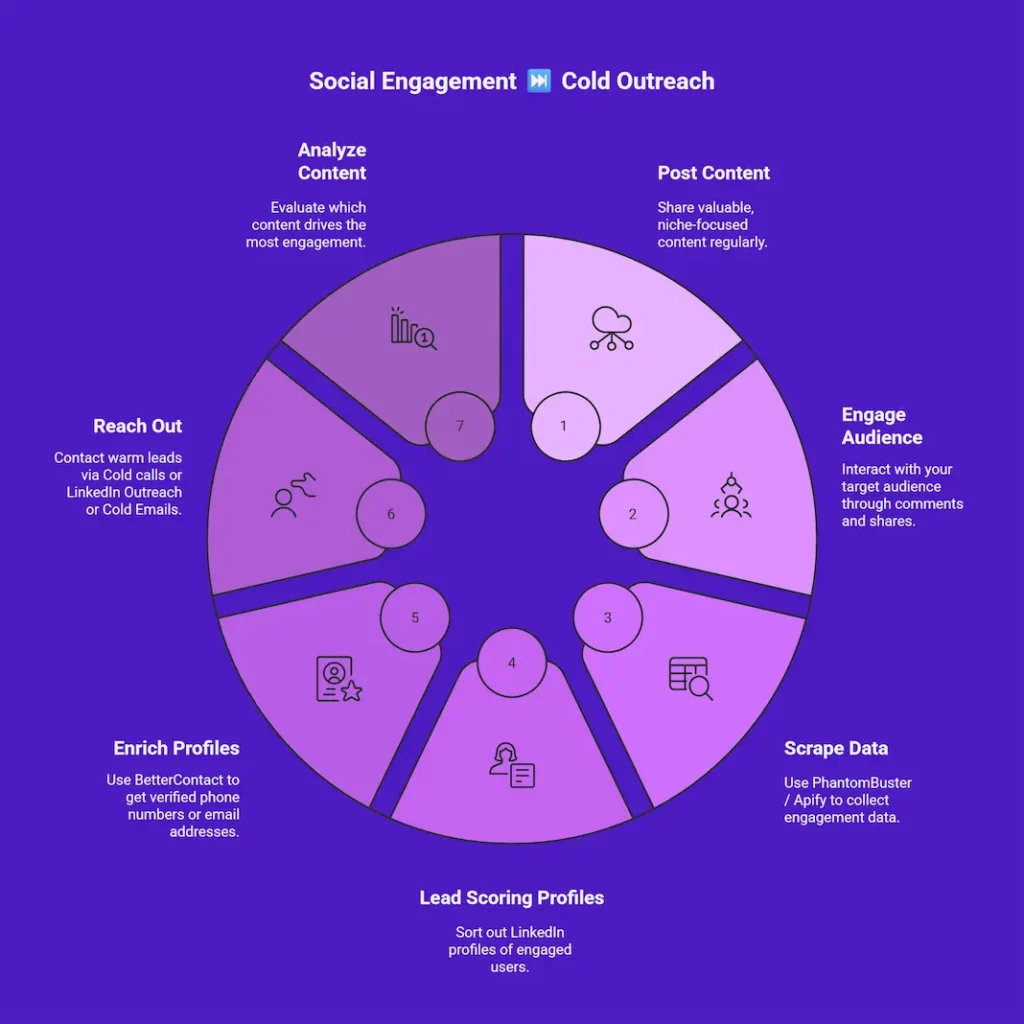
Workflow:
- Build your presence on LinkedIn or any other social media by posting valuable, niche-focused content regularly.
- Engage with your target audience through comments, shares, and DMs.
- Use PhantomBuster to scrape engagement data (likes, comments, shares) from your posts.
- Collect LinkedIn profiles of people who interact with your content.
- Enrich these Leads profiles with BetterContact to get verified phone numbers.
- Reach out to warm leads via cold calls or emails now, as they are already familiar with your content.
- Repeat the cycle by analyzing which content drives the most engaged prospects.
📃Read This: How to generate leads from LinkedIn?
4. Cold Call to Positive Responders
Social engagement opens doors, but positive email responses hand you the keys to close deals faster. When prospects reply with interest, immediately sync them to your CRM using Make or Zapier for organized tracking.
This multi-channel approach transforms B2B sales prospecting into a systematic process. Enrich customer data by checking LinkedIn profiles to understand decision-making authority and pain points. Use BetterContact to grab verified mobile numbers for your hottest leads. Now you’re ready to cold-call with context.
Your follow-ups should reference specific email conversations, demonstrating hyper-personalization that separates you from competitors. Combine email engagement history with phone outreach to create powerful sales prospecting sequences.
This integrated strategy converts interested prospects into closed deals through coordinated touchpoints across multiple channels.
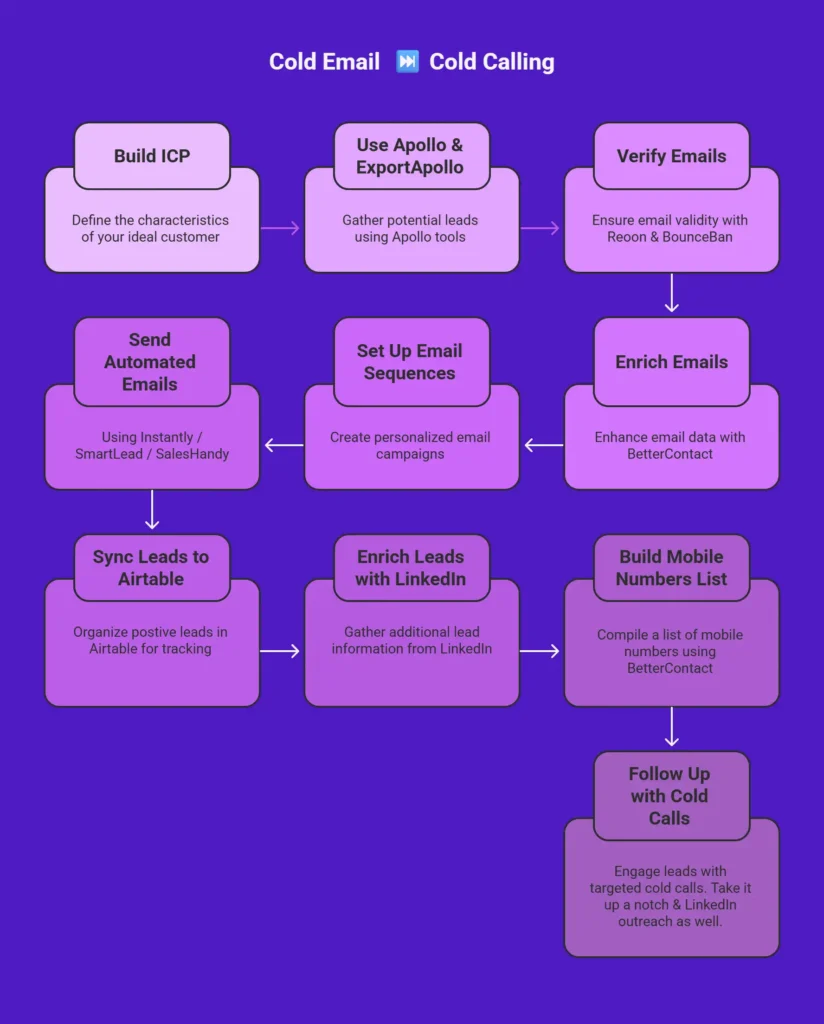
Workflow:
- Build your Ideal Customer Profile (ICP) on BetterContact
- Enrich the ICP’s emails with BetterContact. No need to verify (it provides SMTP & Catch-all double-verified emails.)
- Set up email sequences with hyper-personalized copy and no-brainer offers.
- Use Instantly (or Smartlead / Saleshandy) to send automated cold emails across different regions.
- When leads reply positively, sync them to Airtable using Make or Zapier for organized tracking.
- Enrich leads by reviewing their LinkedIn profiles to understand their roles, interests, and decision-making authority.
- Use BetterContact to build a list of mobile phone numbers for high-potential leads.
- Follow up with a targeted cold call, combining email + phone for a multi-channel approach.
5. Leverage Social Listening
The most valuable prospecting conversations happen before you ever reach out. Social listening lets you monitor online conversations where your prospects discuss their challenges, needs, and frustrations in real time.
Use tools like Hootsuite, Brandwatch, or Sprout Social to track industry keywords, competitor mentions, and relevant hashtags across platforms.
Set up alerts for terms that indicate buying intent or pain points your solution addresses. When prospects mention these triggers, you’ll know exactly when to engage with personalized outreach that directly addresses their stated needs.
This proactive approach transforms cold prospecting into warm conversations. You’re not interrupting, you’re joining discussions where your customer already expressed interest.
Track these social signals consistently to build qualified lead lists and deliver messages that resonate with actual prospect conversations, not assumptions.
Workflow:
- Use Trigify to set up keyword-based notifications
- Ensure the Keywords are your Service/Product Solution based keywords
- Ensure you set up keywords of your Competitors as well
- Scrape the prospects, filter out your ICP using Clay
- Move them to BreakCold for Social Selling
- Or find their Email to run cold email outreach
- If you can’t find their emails, run LinkedIn outreach
- Wherever they respond positively to your pitch, move it to Airtable using Zapier
- Find their mobile phone numbers using BetterContact
- Cold call them using Aircall.
6. Run Networking Events: Webinars & Conferences
Webinars and conferences generate qualified prospects who’ve already demonstrated interest by registering for your event.
Structure your inbound prospecting workflow to maximize conversions:
- Require LinkedIn profile URLs during registration
- Deliver value-driven presentations, positioning your expertise
- Offer free lead magnets to all attendees
- Present high-ticket products after establishing credibility
- Import LinkedIn data into your CRM immediately
Push attendee information through Clay for lead scoring based on job title, company size, and engagement metrics.
Use BetterContact’s waterfall enrichment to obtain mobile numbers and verified email addresses.
Build automated sequences that trigger follow-ups within 24 hours, while prospects still remember your presentation.
Cold call high-scoring leads directly; they’ll recognize your brand from the webinar.
LinkedIn Sales Navigator helps identify additional stakeholders at attending companies, efficiently expanding your qualified prospect list.
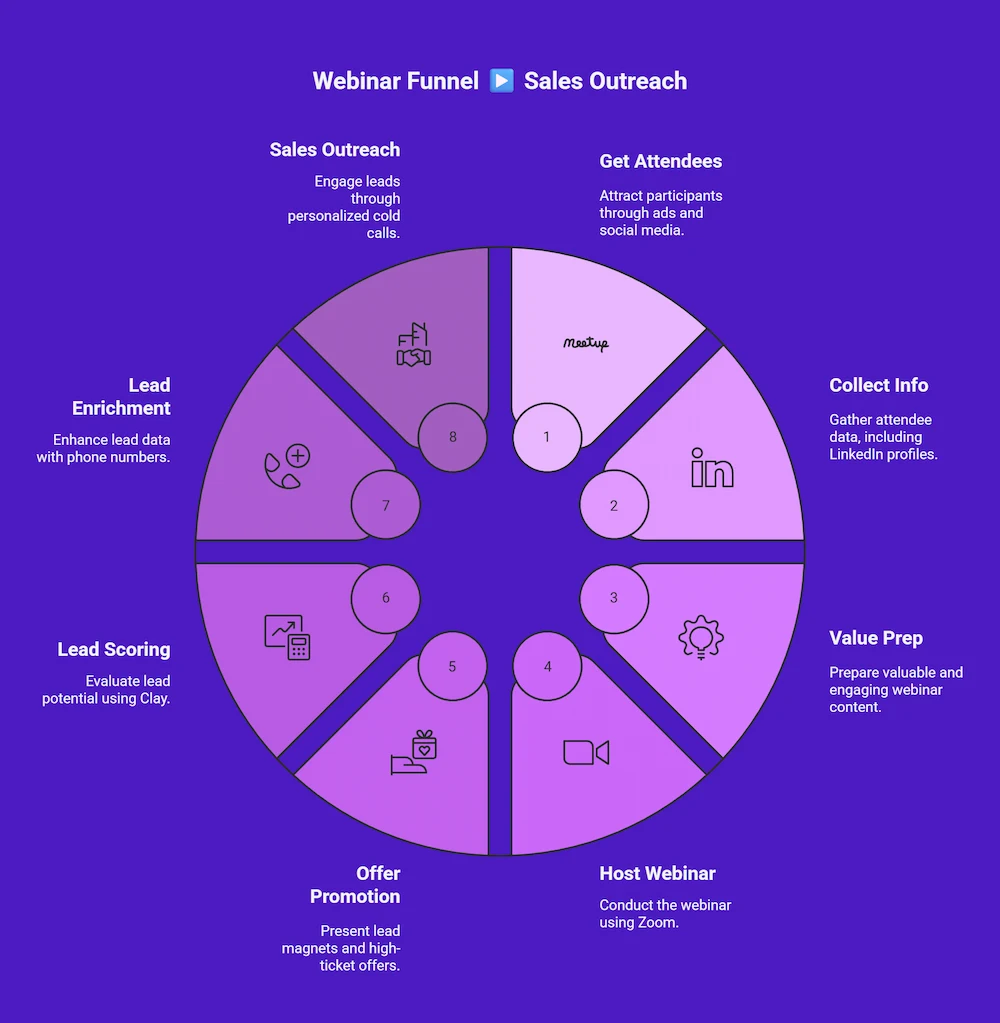
Workflow:
- Ensure attendees complete a form that requests their LinkedIn profile.
- Prepare your presentation.
- Craft the speech.
- Use Zoom to host the webinar.
- Run two offers: one free lead magnet and another for the High-Ticket Offer.
- Push their LinkedIn in Clay to score the prospect.
- Find their phone numbers using BetterContact.
- Cold call them & they’ll know you.
7. Ask for Referrals
While webinars expand your reach to hundreds of prospects simultaneously, referrals deliver something cold outreach can’t, pre-qualified leads who already trust you before the first conversation.
Create a systematic referral program:
- Request referrals immediately after client success milestones, when satisfaction peaks.
- Establish partner exchanges with complementary businesses in your industry.
- Launch alumni programs that generate high-quality leads from former employees.
- Provide custom referral links that simplify sharing for partners and clients.
Warm leads from referrals convert 30% more often than cold outreach leads because they arrive with built-in credibility.
Send this conversion-focused email template after project completion:
Thank satisfied clients for their partnership, offer 10% off their next engagement, then ask if they know others seeking similar results. Include a no-pressure offer for a complimentary consultation.
Referrals won’t scale like automated outreach campaigns, but they consistently deliver your highest-converting leads.
8. SEO Content Marketing
Unlike traditional outbound tactics that interrupt prospects, SEO content marketing positions your company where buyers already search for solutions.
Your website optimization becomes a lead magnet when paired with a thorough content strategy targeting your ideal customers’ search queries.
Workflow:
- Implement technical website optimization, including speed improvements and conversion rate optimization.
- Publish product-led content that addresses specific pain points your prospects research.h
- Deploy visitor tracking tools, such as RB2B, to identify high-intent visitors and their browsing patterns.
- Connect behavior data to your CRM systems for automated lead scoring
- Segment visitors by engagement level and company fit
This SEO strategy transforms anonymous traffic into qualified prospects.
When decision-makers find your content during their research phase, they’re already interested in the solutions you provide.
📃Read This: Scrape LinkedIn like a pro.
9. Account-based marketing (ABM)
Account-based marketing flips traditional prospecting on its head by focusing your entire go-to-market strategy on a curated list of high-value accounts.
Start by identifying companies that match your ideal customer profile, those with the budget, need, and aligned decision-makers. For example, target midsize tech firms with 200-500 employees and $10M+ in annual revenue that are experiencing collaboration challenges.
Next, create personalized outreach that addresses specific pain points. Send relevant case studies showing how you’ve solved similar problems for comparable companies. This approach moves prospects through your sales pipeline faster than generic messaging.
Record Loom videos highlighting key data from your case study to boost engagement. Prospects see your face, hear your voice, and feel you’ve invested personal effort.
This level of personalization transforms standard outreach into memorable interactions that drive higher response rates.
ABM can have infinite workflows.
Here’s one of the best workflows that guarantees results.
Workflow #1: With Ads
- Build your dream lead list in Sales Navigator
- Use Clay to find their Personal Email Addresses
- Run Person-level LinkedIn Ads by uploading their email addresses
- Use BetterContact to find their work emails
- Run Cold Emails and Zap the positive responders back to Airtable
- Send personalized Loom videos addressing their pain points to the positive responders
- Use another Zapier automation on Airtable to enrich the positive responders Mobile Phone Numbers using BetterContact
- Pick up the Phone to cold call them using Aircall.
If you have a bigger budget, you can always use Supercadence.ai
Workflow #2: 20 Days Manual Warm-up
- Build your dream lead list in Sales Navigator
- Push them to Airtable
- Connect with them on LinkedIn
- Interact with them for 2-3 weeks
- Track your interactions on Airtable.
- Use BetterContact to find their work emails
- Run cold email campaigns targeting them.
- Send personalized Loom videos addressing their pain points to the positive responders.
- Zap the positive responders back to Airtable.
- Use another Zapier automation on Airtable to enrich the positive responders Mobile Phone Numbers using BetterContact.t
- Pick up the Phone to cold call them using Aircall.
What makes a good sales prospect?
A good sales prospect matches your ideal customer profile, has a clear need your product solves, and has the authority, budget, and intent to buy. Strong prospects also demonstrate engagement with your brand and are at a stage in the sales funnel, actively evaluating solutions.
- Intent
- Need
- Decision Maker
- Budget
- Fits your ICP
What Is the Sales Cycle From B2B Prospecting to Closed Deals?
Your sales cycle transforms prospects into closed deals through five strategic stages.
Each stage builds momentum by moving potential customers from initial discovery to final commitment, requiring specific actions and personalized engagement at every touchpoint.
You’ll maximize conversion rates by understanding this progression and executing each phase with precision and consistency.
1. Understand Your ICP
Success in B2B prospecting starts with knowing exactly who you’re targeting. Your Ideal Customer Profile (ICP) defines the companies and decision-making teams most likely to buy from you.
According to ListKit, you might achieve a 2-3% response rate with cold outreach. If you truly understand your ICP, you might get a 10-15% response rate.
Build your ICP using firmographic data like industry, company size, revenue, and location. Include technographic details about the tools and platforms your prospects use. This precision streamlines your sales process and improves response rates.
Next, develop detailed buyer personas for each role in the sales qualification process. Identify C-level executives, managers, and influencers within target accounts. Document their responsibilities, pain points, and motivations.
Use platforms like BetterContact to filter prospects by demographic, firmographic, and technographic criteria. These filters help you locate qualified leads who match your ICP, ensuring your outreach reaches the right people every time.
2. Build an untapped prospect list
Once you’ve defined your ICP, the next step is to build a prospect list that competitors haven’t already saturated with outreach. Most sales prospecting plans rely on the same contact databases, such as Apollo or ZoomInfo, creating oversaturated markets.
Here’s how to build untapped prospect lists:
- Use waterfall enrichment to access 20+ data providers simultaneously
- Target verified contact accuracy rates above 98% to avoid spam flags
- Implement segmentation based on geography, company size, and buying signals
- Layer multiple data sources to reach prospects missed by single-provider tools
Traditional prospect list building limits your reach to common databases.
3. Research & Personalize
After building your untapped prospect list, research shows that separating average outreach from campaigns that generate 3-5x higher response rates. Use Clay, Bitscale, or Databar to gather insights from decision-makers at scale.
Focus your research on five critical areas:
- Business model and revenue streams
- Recent company news and funding announcements
- Industry-specific challenges and pain points
- Competitor positioning and market gaps
- Leadership goals from interviews or social posts
Study their LinkedIn activity, company websites, and industry reports. Identify specific challenges they’re facing right now. This allows you to personalize outreach with relevant solutions instead of generic pitches.
Spend 5-10 minutes per high-value prospect researching these elements, and document your findings in your CRM to reference during conversations.
Quality research transforms cold outreach into warm, contextual conversations that resonate with decision-maker priorities.
4. Run Cold Outreach Campaigns
Your researched prospect list becomes valuable only when you execute structured outreach campaigns across multiple channels. As a sales development rep, you’ll need to coordinate cold emailing, cold calling, and LinkedIn prospecting into a single targeted sequence.
Execute these effective outreach tactics:
- Cold emailing: reference specific details about their company or role to demonstrate personalization. Address their pain points directly and propose a clear solution.
- Cold calls: prioritize high-value accounts that require immediate attention. Keep conversations brief and focus exclusively on scheduling meetings, not on pitching products.
- LinkedIn prospecting – Send connection requests with personalized messages, then share relevant industry insights or content.
Run these three channels simultaneously for maximum impact. Personalization remains critical across every touchpoint you create.
5. Follow up & Nurture
Most sales conversations won’t convert on first contact; your prospects need consistent, valuable touchpoints before they’re ready to buy. As a sales rep, implement systematic follow-up sequences to nurture relationships throughout the customer journey.
Execute these follow-up strategies:
- Send personalized emails within 24 hours referencing specific conversation points
- Share valuable content like case studies addressing their documented pain points
- Make strategic calls at different times to maximize engagement
- Monitor social media activity and comment thoughtfully on their posts

Did You Know? According to Martial Group, 60% of clients never respond to proposals unless followed up on.
So, address objections directly in your communications and propose clear next steps.
Track response rates across different touchpoints to identify what resonates. Your persistence demonstrates commitment, while nurturing builds trust that converts prospects into customers.
6. Qualify the prospects
Not every prospect deserves equal time and effort. Qualification separates viable opportunities from dead ends.
You need frameworks like BANT (Budget, Authority, Need, Timeline) or CHAMP (Challenges, Authority, Money, Prioritization) to assess fit systematically.
Ask open-ended questions to uncover specific pain points and business goals. Identify who controls purchasing decisions; reaching decision-makers early prevents wasted cycles with influencers who can’t close deals.
Determine budget availability upfront. A prospect with urgent needs but no allocated funds won’t convert this quarter.
Evaluate timeline urgency. When do they need a solution implemented?
Use Clay to qualify your TAM efficiently, filtering prospects against your ideal customer profile criteria.
Strong qualification guarantees your pipeline contains genuine opportunities, not just inflated contact numbers that drain resources without delivering revenue.
7. Schedule a meeting
Scheduling converts interested prospects into qualified opportunities through structured conversations that reveal deal potential.
You’ll move qualified leads from your pipeline into strategic sales interactions by proposing discovery calls that uncover specific business challenges. This shift from marketing solutions to direct communication greatly impacts your conversion rates.
Execute these steps to secure meetings:
- Reference specific pain points from your qualification research
- Propose two concrete time slots within the next week
- Frame the call as a collaborative problem-solving session
- Send calendar invites immediately after confirmation
- Prepare a strategic discovery framework before each interaction
Your preparation determines meeting effectiveness. Review all previous communication, research recent company developments, and align your solutions with their documented needs.
This groundwork transforms scheduling from an administrative task into a pipeline-acceleration effort.
8. Provide Value & Handle objections
When prospects raise objections, they’re signaling interest, not rejection. Your response determines whether the conversation advances or stalls.
Provide value through sales intelligence that addresses their specific concerns with personalized solutions. Deploy empathetic questions to uncover root causes: “What specifically about the implementation timeline concerns you?” Listen actively before responding.
Handle objections using the NEPQ framework:
- Empathize & Pause: Acknowledge their concern without rebuttal; let them feel heard.
- Ask Probing/Clarifying Questions: Dig deep to find the root cause, not just the surface objection. Example: “What specifically about [issue] are you struggling with?”
- Isolate the Objection: Determine if it’s a real barrier (money, need) or a polite brush-off (spouse, timing).
- Use Identity Framing: Get them to distance themselves from the “problem person” (e.g., “Do you want to be like executives who never get healthy or overweight?”).
- Reframe with Value: Shift the focus from the problem to the positive outcome or possibility, often with a trade-off.
- Confirm & Close: Once resolved, confirm the solution and guide the conversation forward.
Build trust by being transparent about pricing, competitors, and the realities of implementation.
Offer product demos so prospects can experience the value firsthand. When you resolve objections collaboratively rather than defensively, you position yourself as a trusted advisor, not another vendor pushing features.
9. Close & Repeat
The sales cycle culminates in the close, where qualified prospects become paying customers, and initial prospecting investments deliver measurable returns.
If you’re an SDR, hand off qualified leads to your account executive team for negotiation and deal closing. If you’re an AE, present pricing, address final concerns, and secure commitment. Always ask directly for the sale.
Use closed-ended questions:
“Shall I send the contract?” or “Can we move forward with this agreement?”
Many deals fail because salespeople never explicitly request commitment.
After closing, extract lessons from your sales cycle. Document which messaging generated responses, which objections appeared most frequently, and where prospects showed the strongest engagement. Apply these insights to your next prospecting campaign.
Continuous refinement transforms prospecting from random outreach into a predictable revenue engine.
Inbound vs. Outbound Sales Prospecting
The main difference between inbound and outbound sales prospecting is how prospects are engaged. Inbound prospecting attracts potential customers through content, SEO, and social media, enabling them to initiate contact based on their interests. Outbound prospecting proactively reaches prospects through cold emails, calls, ads, and events to generate immediate awareness and leads.
| Aspect | Inbound Marketing | Outbound Marketing |
| Strategy Type | Pull strategy – attract customers to you | Push strategy – proactively reach out to customers |
| Approach | Let prospects come to you based on interest | Initiate contact and reach customers directly |
| Customer Relationship | Build long-term relationships and trust | Generate quick awareness and leads |
| Key Methods | Content marketing, SEO, Social media, blogs, newsletters, and podcasting. | Cold calling, cold emails, LinkedIn Outreach, Outbound DMs, paid ads |
| Targeting | Attracts qualified leads already seeking solutions | Broad audience reach, hoping to find interested buyers |
| Interaction Style | Helpful and educational | Interruptive and attention-grabbing |
| Cost Effectiveness | Cost-effective over time | Can be costly with immediate spend |
| Speed of Results | Takes long time to build momentum | Fast results and quick brand awareness |
| Customer Perception | Organic and relationship-focused | Can be seen as intrusive |
| Scalability | Requires consistent content creation | Highly scalable for a wide reach |
What Is the Best B2B Prospecting Tool?
There is no single best B2B prospecting tool because the right choice depends on your goals and workflow. BetterContact stands out for global data coverage, 3 billion contact records, 20+ data integrations, and a waterfall lead-finding system. LinkedIn Sales Navigator excels at relationship building; ZoomInfo provides large-scale data; Apollo.io combines data and outreach; and Cognism offers GDPR-compliant U.S. data.
Quick Look:
- Bettercontact: Leverage 3 billion contact records with waterfall lead finder technology across 20+ integrated data providers. Including Apollo.
- LinkedIn Sales Navigator: Build relationships with decision-makers through advanced search filters.
- ZoomInfo: Access massive databases with detailed firmographic data
- Apollo.io: Execute complete prospecting workflows in one platform
- Cognism: Obtain GDPR-compliant international contacts
The best tool combines accurate data with seamless CRM integration to boost your conversion rate.
Focus on platforms that verify email addresses in real time and support multichannel outreach strategies.
Your B2B prospecting success depends on choosing tools that align with your specific market and sales process.
What Are the Different Types of B2B Prospects?
Understanding prospect classifications sharpens your targeting strategy and improves conversion rates across your sales funnel.
You’ll encounter two distinct prospect types in your B2B contact database:
Sales Prospects
These individuals match your ICP, and you’ve proactively identified them for outreach. You’ll contact them through:
- Cold calling campaigns
- Outbound email sequences
- Social media connection requests
- Multi-channel sales cadence approaches
Marketing Prospects
These contacts have voluntarily engaged with your content marketing materials. They’ve demonstrated interest by:
- Requesting product demos
- Completing website forms
- Downloading gated resources
Marketing prospects typically deliver higher lead-to-opportunity conversion rates because they’ve already shown intent.
Sales prospects require more touchpoints,s but expand your addressable market beyond inbound channels.
You’ll need different messaging strategies for each type to maximize response rates and pipeline contribution.
Why Is B2B Prospecting Important?
Without consistent prospecting, your revenue pipeline dries up within 90-180 days, regardless of your current customer base.
B2B prospecting drives sustainable growth by consistently feeding your sales funnel with quality leads who need your products.
Here’s why it’s critical:
- Pipeline Stability: You’ll maintain predictable revenue streams instead of experiencing feast-or-famine cycles.
- Marketing Alignment: Prospecting bridges the gap between marketing campaigns and sales execution, ensuring both teams work toward shared goals.
- Efficiency Gains: Optimized prospecting processes reduce your sales cycle by 20-30%, accelerating deal closure.
- Revenue Growth: Companies with structured prospecting consistently outperform competitors by identifying opportunities before the market saturates.
Without active prospecting, you’re gambling with your company’s future.
Build systematic prospecting habits now.